
Your roof, your tenants, your neighbours
Solar power sold inside the building is worth far more than its feed-in tariff – and still cheaper for the tenants than their supplier. Cantabile prices it fairly, runs the building's battery and devices with it, and shows everyone what they gain.
Mieterstrom, GGV and Energy Sharing
German law offers three ways to share local solar power. Cantabile supports all three; per plant the operator chooses one.
Mieterstrom
§42a EnWGThe plant operator supplies the tenants completely: roof power plus the residual power it buys from the grid. The price is capped at 90 % of the local basic-supply tariff. The contract must be separate from the lease. A Mieterstrom premium is paid for solar power the tenants use directly.
GGV – shared building supply
§42b EnWGSince May 2024 the lighter model: tenants get a share of the roof's power per quarter-hour and keep their own supplier for the rest. No price cap, no full-supply duty for the operator. Every participant needs quarter-hourly metering (a smart meter).
Energy Sharing
§42c EnWGSharing across the public grid with neighbours in the same grid area – since June 2026; with the adjacent grid area from June 2028. The shared kilowatt-hour pays the full grid fees and levies, so the margin lies in the energy part of the price.
This page describes our reading of the law in plain words. Cantabile does not give legal or tax advice. Before any tenant is billed, the calculations and our contract templates go through review by lawyers and tax advisers; where the law can be read in two ways, Cantabile applies the stricter reading until that review decides.
Side by side
| Mieterstrom (§42a) | GGV (§42b) | Energy Sharing (§42c) | |
|---|---|---|---|
| Who takes part | Tenants of the building (or the same neighbourhood ensemble) | Tenants of the building | Members across sites in the same grid area |
| What the price covers | All of the tenant's power, including residual power | Only the allocated solar share | Only the shared kWh – the energy part |
| The rest of the power | Bought by the operator | The tenant's own supplier | The member's own supplier |
| Price limit | At most 90 % of the basic-supply tariff | None by law; Cantabile keeps each tenant below their own tariff | None by law; never above the member's own supplier |
| Through the public grid | No | No | Yes: grid fees and levies apply |
Swipe the table sideways to see all three models.
Priced by competition, earned by dispatch
A tenant compares with what they would pay otherwise. So each tenant's price follows their own alternative – their supplier's price in that quarter-hour, or the basic-supply tariff – and stays below it.
The owner's gain comes from more roof power used in the building: each such kilowatt-hour earns close to a retail price instead of a feed-in rate of a few cents. The building's battery and the flats' own flexibility – reported by their boxes – move use into the sunny hours.
- One optimisation sets the prices and the battery's schedule together, owner's gain first, then the tenants' savings.
- Simple offers: two to four price bands per day, published a day ahead – or, in GGV, "X % below your own tariff in every quarter-hour".
- Guarantees: the Mieterstrom cap per kilowatt-hour; never above the tenant's own tariff in any quarter-hour; an annual comparison on the bill.
- The loop closes: the offer goes into the tenants' boxes as their tariff, so their heat pump, battery and car follow the sun.
- 1Solar roof of the building
- 2Flats: tenant power at their own offer
- 3Building battery: charged only from the roof, discharged only into the flats
- 4Grid connection: residual supply and feed-in
- 5Neighbours across the public grid (§42c)
The offer, the energy, the investment, the history
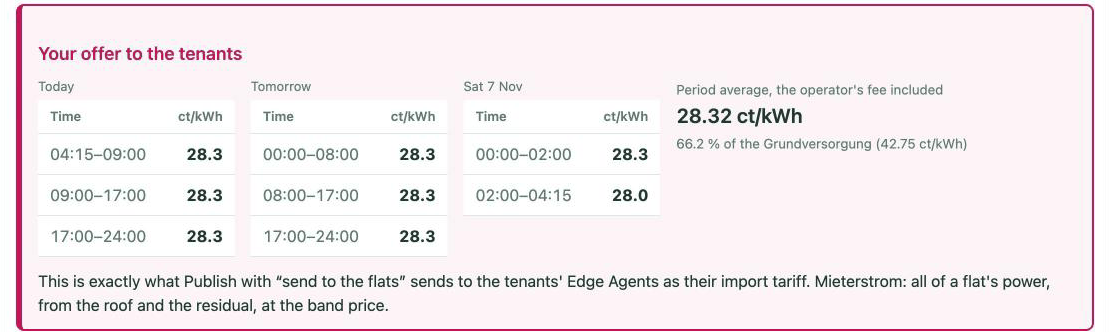
The offer
The bands per day, the average price, what the tenants save – and what goes into their boxes when it is sent.
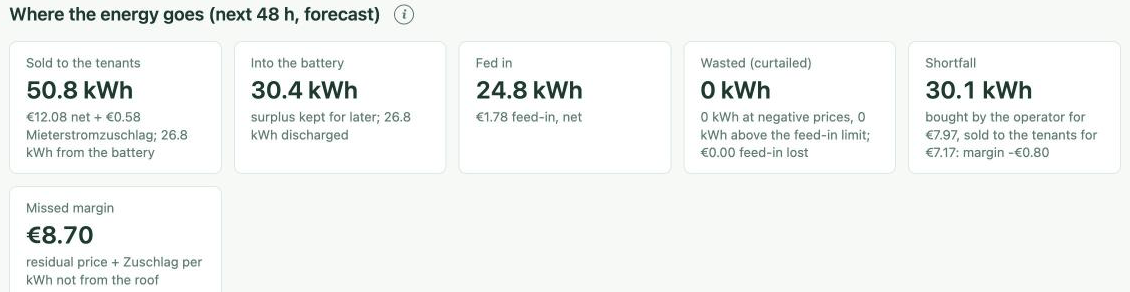
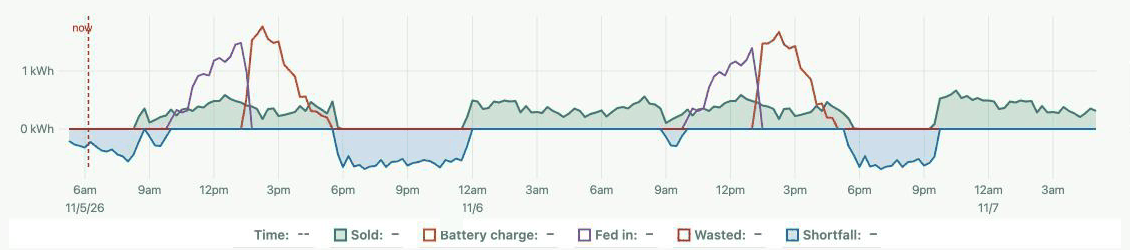
Where the energy goes
Sold in the building, stored, fed in, curtailed, or short – per quarter-hour and in total, with the money each path earns or misses.
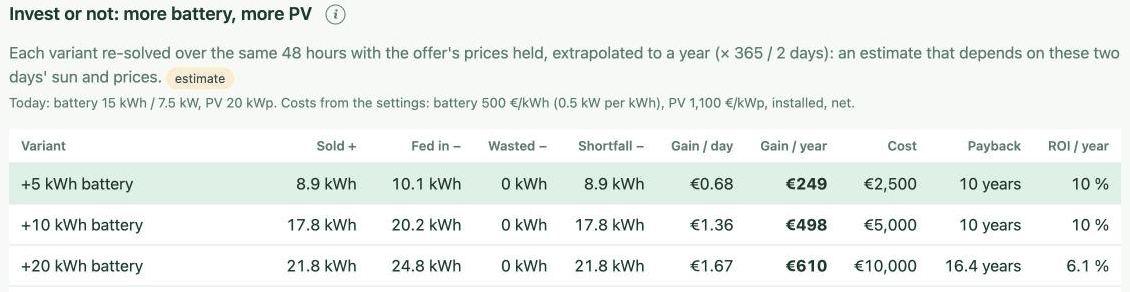
Invest or not
The same period with a bigger battery (+5, +10, +20 kWh) or more PV (+5, +10 kWp): extra sales, payback time and return – with your own quotes as costs.
History
Per day, month and year from the meters: generated, sold, fed in, the tenants' savings, the owner's money, planned against actual.
Privacy by design: the operator sees sums and the worst-off flat's percentage – never a single flat's time series. Billing data is used for the bill only.
What a building operator sees
Screenshots from the Cantabile console for a simulated Mieterstrom building in Cologne-Ehrenfeld (November 2026).
An example from the simulated fleet
A simulated building in Hannover-Linden with seven flats, GGV and a 12 kWh battery; 48 hours in November 2026, with the real 2026 tariffs of the area. The operator chose "15 % below each tenant's own tariff".
These are results of the platform's pricing on a simulated building, not a customer's bill. Results depend on sun, season, tariffs and the building. In the same November week a simulated Mieterstrom building in Dresden showed a small loss for the owner (−€1.15 over 48 hours): little sun, and residual power bought dearer than it may be resold under the cap. Cantabile shows such cases plainly instead of pricing them away.
Legal since 2026 – and almost unused
The law is there, but few smart meters, missing processes and full grid fees on every shared kilowatt-hour keep uptake near zero. What it needs is software that handles quarter-hourly allocation, fair prices and members across grid areas – and partners in the energy industry.
Cantabile checks each member against the plant's grid area and its metering, allocates per quarter-hour (pro rata or by fixed shares), prices only the energy part and never above a member's own supplier, and charges the community battery from the plant only.
Our path: with a Stadtwerk
We start with a Stadtwerk or another supplier as partner – as supplier, balancing-group manager and often metering operator – and Cantabile as the platform for sharing, optimisation and the billing items. Cantabile does not become a supplier itself.
A building with a solar roof?
Let's look together at what tenant power could mean for your building and your tenants.