
One stack, four layers
From the device on the wall to the market in the cloud, Cantabile is built as one system. Each layer works on its own and gets better with the one above it.
Hardware
Existing devices through Home Assistant; our own white-label ESPHome devices for buildings without smart-home infrastructure.
Hardware line comingHub OS
Our own operating system: A/B slots, signed updates, apps as signed add-ons, Home Assistant included.
TodayEdge Agent
Beside Home Assistant on every site: plans, acts through a safety guard, keeps working offline.
TodayCloud platform
Fleet, forecasts, tariffs, buildings and communities, the market, insights – a workspace for every role.
PilotHardware: what is there, and what is missing
Most buildings already have devices worth using: inverters, batteries, heat pumps, wallboxes. Cantabile reads and controls them through Home Assistant and its more than 2,000 integrations. Where a building has nothing to connect, our own hardware line closes the gap.
Integrate what is there
Today- Inverters, batteries and heat pumps over Modbus RTU/TCP, with our Modbus bridge
- Zigbee and Thread devices with any common radio stick; Matter
- Heat pumps and wallboxes via EEBUS, including the grid operator's §14a limit (field tests coming)
- Thermostats, shades, temperature and humidity sensors, weather
- Device profiles turn each vendor's device into one common model
White-label ESPHome hardware
ComingLow cost per flat, open firmware, no vendor lock-in. Planned devices:
- Energy gateway – one Modbus poller for inverter, battery, wallbox, heat pump
- Meter reader – smart meter (SML via infrared), gas and water pulses
- Heating adapter – OpenTherm, eBUS and others, plus SG Ready contacts
- Room node – wall switch with Wi-Fi presence and temperature/humidity
- Radar presence node, radiator probe, load controller, climate bridge, safety node (leaks, water shut-off), building controller (M-Bus, KNX, BACnet)
The Cantabile Hub: an operating system that updates itself safely
The Hub is a compact box with our own Debian-based operating system. The system lives in two slots: an update is written to the inactive one, checked, and only then started. If it does not come up, the box returns to the old slot by itself.
- Signed and verified – every system update is signed; the system partition is verified at boot (dm-verity).
- Apps as signed add-ons – Home Assistant, Matter, the Thread border router, the MQTT broker and the Edge Agent each update on their own.
- Home Assistant backed up first – before every Home Assistant update; restored if the new version does not start.
- Release channels – stable, beta and dev; each release goes through an automated check on test boxes first.
- Guided setup in German or English: owner, network, location, radios, consent, done – resumable at any time.
- Move an existing Home Assistant onto the Hub from a backup.
Already running Home Assistant?
The same Edge Agent is available as an add-on for Home Assistant OS and Supervised installations, from our public add-on repository. Owners keep their own update rhythm; on a Home Assistant version we have not tested yet, the agent falls back to observing until it is supported.
The Hub is fully supported; the add-on is compatible. Binding commands such as the grid operator's §14a limits run only on tested versions.
The Edge Agent: the brain beside Home Assistant
Home Assistant talks to the devices. The Edge Agent decides what they should do – on site, every 15 minutes, for the next 48 hours.
Plans
A mathematical optimisation over prices, forecasts, comfort and limits. It re-plans within seconds when a new tariff, model, limit or command arrives. How it plans
Acts safely
Every command passes a guard: consent per device, the device's bounds, rate limits, minimum run times for compressors, and hands off when someone switches by hand.
Starts by watching
New sites start in shadow mode: the agent plans and shows what it would do, and acts on nothing. Advisory and automatic mode follow, control by control.
Talks out, never in
Only outbound connections – no port forwarding into homes. Tariffs and models arrive as signed bundles, checked on the box.
Learns locally
The box trains its own forecast models every night from its own history – even without the consent to share data; then nothing leaves the box.
Fits into Home Assistant
Areas, entities and dashboards are set up for the owner; the plan and market values appear in Home Assistant too.
The cloud platform and the console
One web console in German and English. Every login works in its own workspace and sees only its own organisation's data.
Fleet
Every Hub and add-on site: status, hardware, devices, the agent's plans and actions, updates per channel, an add-on store with four-eyes review, remote help only with the owner's consent – all in an audit log.
Forecasts and models
Load and solar forecasts per site from the weather of the German Weather Service (DWD), physical PV models calibrated to the plant, and room models; sent to the boxes as signed bundles.
Tariffs
Supplier products, grid fees per grid area with §14a time windows, levies, taxes and fixed charges, composed into each site's price curve. Tariffs and costs
Buildings and communities
Members, rules, consent per recipient, the building's plan, tenant power and Energy Sharing. Tenant power
Smart Market
Players, contracts in plain words, and a ledger per quarter-hour from metered energy – today in shadow: calculated and shown, nobody is billed.
Insights
Consumption, solar, grid, battery, self-consumption and autarky, the models' accuracy and monthly reports.
Workspaces
Staff · supplier · grid operator · building operator · community operator · metering operator · installer · analyst. A workspace for residents is coming.
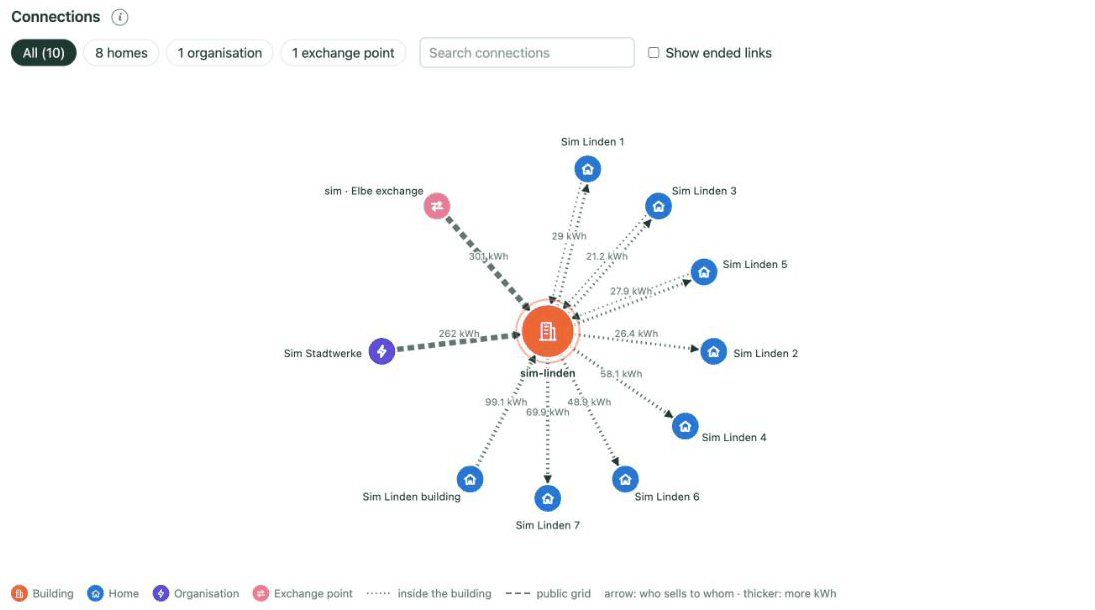
See the platform on a real building
We show the console and a Hub live, on the simulated fleet or on your site.