
Shave the peaks, share the flexibility
Heat pumps, cars and batteries can wait a little, start a little earlier or give back power. Used together, that flexibility lowers bills, keeps building connections within their limits and takes pressure off the local grid.
- Load without coordination
- Load with Cantabile
- Connection limit
How a building stays under its limit
- Each box reports its flexibility for the next 24 hours: how much it could hold back in each quarter-hour, from the facts of its devices.
- The building coordinator plans the whole building: it keeps the connection under its limit and moves use into cheaper, sunnier hours.
- The flats receive requests – shift this, stay under that – and follow them within the comfort floors of their residents.
Energy is moved, not lost: what is held back at the peak is used before or after. A flat that keeps overriding requests is asked less.
One flexibility, many beneficiaries
Homes
Use your own solar power and the cheap hours; keep the grid connection's peak low and the comfort high.
Buildings
Shared heat pump, garage chargers and flats under one connection limit; more of the roof's power sold to the tenants.
Communities
The same planning one level up: several buildings and homes, one community battery, shared power.
Suppliers
Customers on dynamic tariffs shift into cheap hours; the residual supply they draw is visible and priced at the day-ahead price.
Grid operators
§14a orders are followed and confirmed; feeder load can be compared against limits; flexibility becomes visible where the grid is tight.
Everyone
Less solar power pushed into the grid at noon, fewer evening peaks – a grid that can carry more heat pumps and cars.
The grid operator decides – Cantabile follows
Under §14a EnWG, the grid operator may dim heat pumps, wallboxes and other controllable devices when the local grid is at risk of overload – as a rule not below 4.2 kW per device, and never off. In return their owners pay a reduced grid fee.
- Cantabile never generates §14a orders. They come only from the grid operator's control box.
- The box verifies each order's signature, follows it at once and plans around it: the car charges later, the battery covers the house.
- Orders are shown and confirmed to the grid operator in its own workspace, with what each box applied.
- Toward the control box, the box declares only known power ratings – never a guessed value.
- An order of the grid operator ranks above everything else and is never penalised in the market.
Sealed meters
A meter sealed for a grid or metering operator is read-only for everyone else, and Cantabile never switches it. Only that operator can lift the seal or hand it on.
EEBUS support for §14a is implemented; field tests with real control boxes are coming.
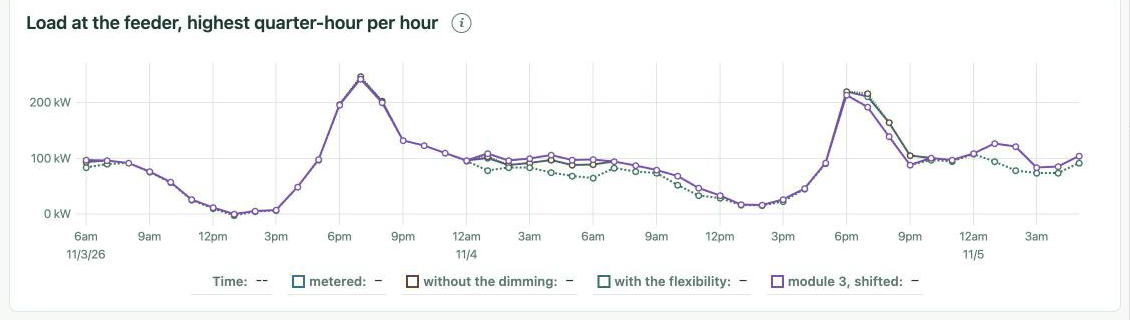
A feeder's load, and what flexibility does to it
The grid operator's analysis compares a feeder's metered load with what it would have been without the §14a dimming, with the homes' reported flexibility, and with consumption shifted by the module 3 time windows.
Why many small decisions keep the grid steady
The energy transition puts heat pumps, cars and solar roofs on the same low-voltage lines. Each one alone is harmless; at the same moment they create peaks. Coordinated, they smooth them.
Midday
Solar power is used and stored in the building instead of all flowing into the grid at once.
Evening
Batteries cover the evening peak; cars charge later in the night, when the lines are free and power is cheap.
When it is tight
The grid operator's limits are followed in seconds, and every box keeps its residents comfortable within them.
A grid operator or a feeder with a problem?
Let's look at where flexibility could help in your area.